How Deep Should Raised Bed Soil Be for Optimal Vegetable Growth?
- Deeper soils enhance water retention and temperature stability. **Debated:** - The optimal depth for specific vegetable types.

- Deeper soils enhance water retention and temperature stability. **Debated:** - The optimal depth for specific vegetable types.
Unterstützende Videos
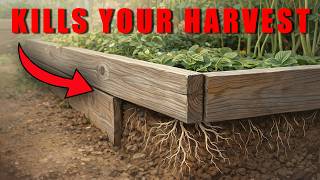
The Raised Bed Depth Nobody Talks About (And Why It Changes Everything About Your Harvest)
Peer-Reviewed Wissenschaft
VerifiziertFood and Agriculture Organization
Miguel A. Altieri
University of California, Berkeley
USA
Agroecology and the design of climate change-resilient farming systems — Agronomy for Sustainable Development
Simon Goddek
University of Iceland
47661 Issum, Germany
Challenges of Sustainable and Commercial Aquaponics — Sustainability
Ranjan Bhattacharyya
Indian Agricultural Research Institute
New Delhi 110 012, India
Soil Degradation in India: Challenges and Potential Solutions — Sustainability
Ina Opitz
Muhammad Ayaz
Kevin D. Hyde
Kunming Institute of Botany
Kunming 650201, People's Republic of China
The amazing potential of fungi: 50 ways we can exploit fungi industrially — Fungal Diversity
Monisha Jaishankar
Sujata F. Harlapur
Md. Mahfuzur Rahman Shah
Gernot Bodner
Chulalux Wanitchayapaisit
Claudia Kammann
Mingyu Yang
Samer Fawzy
Christian Thierfelder
Ricardo Cavicchioli
UNSW Sydney
School of Biotechnology and Biomolecular Sciences, The University of New South Wales
"ommunities by providing microhabitats that favor carbon-fixing bacteria, leading to increased polysaccharide production and reduced CO2 efflux by 15% through pathways like enhanced nitrogen fixation and altered gene expression for carbon assimilation"
Scientists’ warning to humanity: microorganisms and climate change — Nature Reviews Microbiology
Jos M. Raaijmakers
Wageningen University & Research
Wageningen, the Netherlands
The rhizosphere: a playground and battlefield for soilborne pathogens and beneficial microorganisms — Plant and Soil
Pedro A. Sánchez
Hoi-Fei Mok
Jonathan P. Lynch
Rui Machado
William J. Lamont
Majeti Narasimha Vara Prasad
Leslie A. Weston
Mohamed A. E. AbdelRahman
Christopher Chibueze Azubuike
University of Port Harcourt
East-West Road, Port Harcourt
Bioremediation techniques–classification based on site of application: principles, advantages, limitations and prospects — World Journal of Microbiology and Biotechnology
Charles Darwin
Steven R. Archer
Chennu Sowmya
Quan‐Hoang Vuong
Abbas Jafar
Simon Goddek
Dhivya Elavarasan
Shahida Anusha Siddiqui
Indian Agricultural Research Institute
Formerly at ICAR-Indian Agricultural Research Institute
J.C. Sutton
Ersin Elbaşı
Saikat Biswas
Mamunur Rashid
Paolo Sambo
Christian Riuji Lohri
John Taylor
Ruth Nattassha
K. Subrahmaniyan
Nazir Ahmed
Riccardo Scotti
Jiban Shrestha
Julius Reiff
Bijay Sıngh
Giuseppe Colla
Pete Smith
İbrar Ahmed
Denis J. Murphy
Shahida Anusha Siddiqui
Bernard Vanlauwe
Sujit Adhikary
Redmond R. Shamshiri
Anil Kumar
Charles Lathrop Pack
Miguel A. Altieri
Gabrijel Ondrašek
Dimitrios Savvas